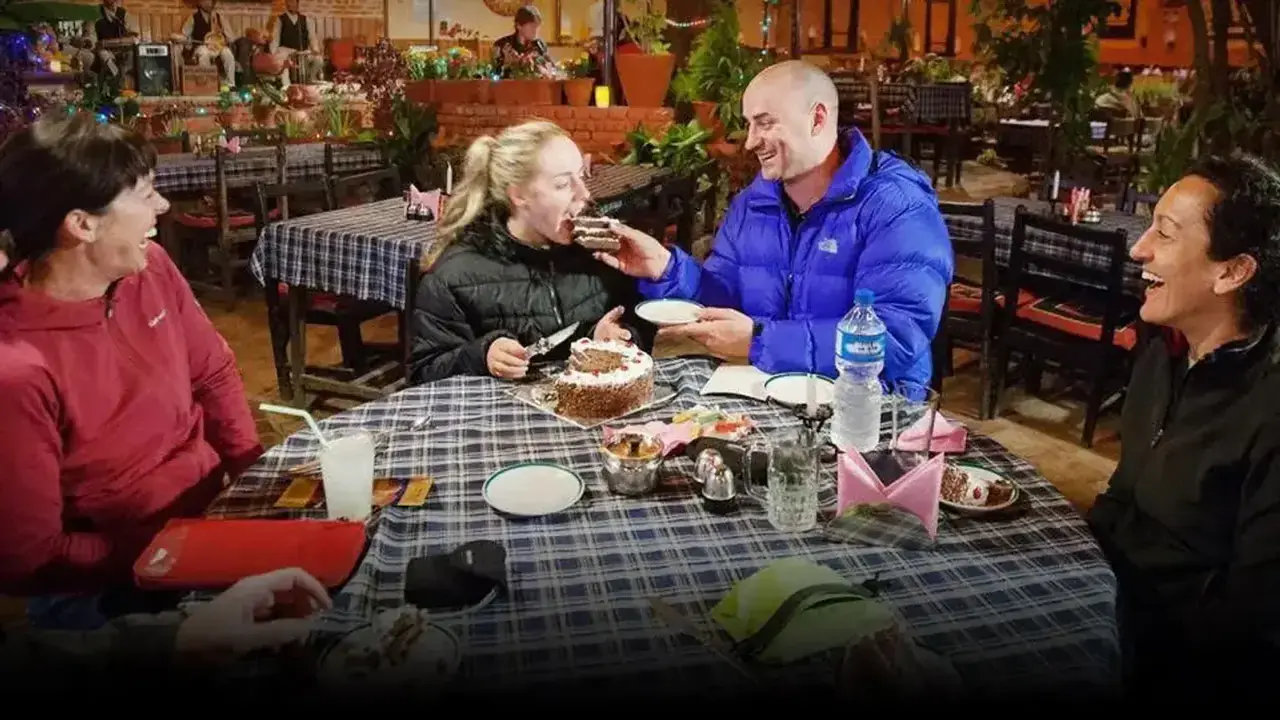

A four-stringed lute carved from a single block of wood, a barrel-shaped drum, a bamboo flute, and seven musicians who inherited the music from their fathers and their fathers before them. That is the Gandharva ensemble — the living memory of Nepali folk song — and it has been playing in our garden every evening, for the last twenty years and more.
Who are the Gandharvas?
The Gandharvas are a hereditary caste of Nepali folk musicians — for centuries they were the travelling poet-singers of the Himalayan foothills, walking from village to village carrying news, devotional songs, praise poetry and the occasional gossip. Before radio, they were how the news travelled. They are mentioned in Sanskrit texts. They are still here.
The community is concentrated in the western mid-hills of Nepal — particularly around Tanahun, Lamjung and Pokhara — but Gandharva musicians have always migrated, and ensembles like ours bring the tradition to Kathmandu, where most travellers will hear it for the first and often the only time.
What the instruments are
The Sarangi
A four-stringed bowed lute carved from a single block of wood — typically khirro wood, kept in the family. The strings are traditionally goat gut; modern players sometimes substitute steel. The bow is short and held overhand. The Sarangi has a melancholy, vocal sound — it imitates the singing voice and is the lead instrument in any Gandharva ensemble. If you have heard it in a Kathmandu film soundtrack or a Bollywood ballad, that is the one.
The Madal
The Nepali drum — a barrel-shaped, two-headed wooden drum played horizontally, struck with the hands. The two heads are tuned differently and produce two distinct notes. It is the heartbeat of every Nepali folk song. Some Gandharva ensembles use the larger Maadal; ours uses the standard size, played by a musician whose father played the same instrument.
The Bansuri
A bamboo transverse flute. Six finger holes, no keys. Capable of extraordinary subtlety — quarter-tones, slides, breathy attacks. In a Gandharva ensemble the Bansuri trades melodic lines with the Sarangi.
What it sounds like
Gentle. The Gandharva tradition is not loud music. It is dinner-conversation volume by design — the original village context was a courtyard at dusk, a small audience, no amplification. In a garden setting it is precisely the right volume to be present without being intrusive. You can talk over it. You can also stop talking and listen.
The repertoire mixes traditional folk songs (Resham Firiri is the famous one, the song most travellers leave Nepal humming), devotional pieces, and increasingly pieces composed by the musicians themselves. Songs are sung in Nepali; some are introduced briefly in English on request.
Where to hear it in Kathmandu
Honestly: the options in Kathmandu are very few. Gandharva music exists everywhere in Nepal, but staged Gandharva music in restaurants is rare — most venues default to recorded music or to louder bar bands.
- Northfield Cafe (Thamel) — A six-to-seven musician Gandharva ensemble plays in our garden every evening from approximately 7:00 PM to 9:30 PM. Free with dinner. Musicians visit individual tables on request. This is the venue we know best because it is ours; we mention it because there are very few alternatives.
- Thamel House Restaurant — Sometimes hosts traditional Nepali music with the multi-course meal. Check ahead.
- Krishnarpan at Dwarika's Hotel — In Battisputali (a taxi from Thamel). Live Nepali musicians accompany the multi-course tasting menu.
- Nepali Chulo (our sister restaurant) — Traditional Nepali music with traditional Nepali food. Slightly more formal.
How to listen well
- Sit close enough to hear the bow on the Sarangi strings — about three to five metres is ideal. Tables on the inner ring of the garden are best.
- Tip the musicians directly at the end. A few hundred rupees per musician is more than appropriate.
- Ask for a song. Resham Firiri is the obvious request; ask for something less famous if you want to surprise them.
- If it is your birthday, mention it at booking. The band will come to your table at the right moment, a cake will appear that you did not order, and the whole garden will sing.
“The Sarangi player came to our table on my partner's birthday and the whole garden sang. They brought out a cake we didn't order. I cried. Genuinely.”
Music plays nightly, 7:00 PM – 9:30 PM. Free with dinner.